
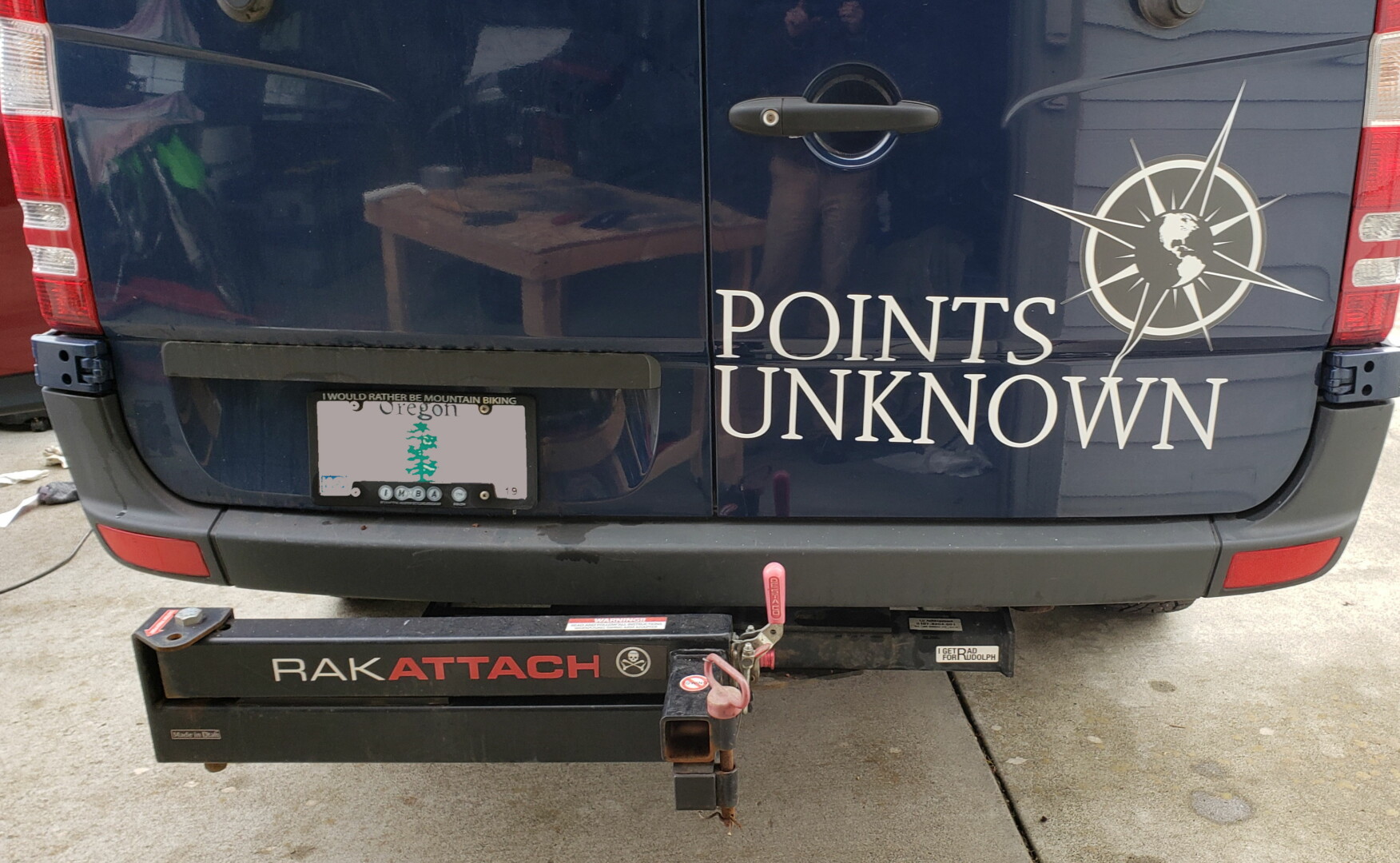
RakAttach Fail: An unfortunate long term review
TL:DR – The RakAttach is a great accessory for your receiver hitch and 5 years ago it was a one-of-a-kind product. At achieving its core function, to swing out and provide access to the back of our van, while being robust enough to hold 5 bikes – I give it a 10 out of 10. For longevity and quality of construction, I give it a 5 out of 10, due to coating issues.
I’ve written extensively about our awesome bike rack setup; how we use it, how we converted it to hold skis; and even made videos about it. And given how big of a fan I must sound like, I now feel obligated to provide this long-term review of the RakAttach, a core component of our setup. And ultimately, show how it failed.
In the beginning (the good)
RakAttach was first released in 2015. At the time, it was very unique, with no equal (that I know of) on the market. I don’t think I realized this at the time, but we must have snatched one up pretty early on in production – because we got ours early in 2016 and their website indicates they only started making them in the Spring of 2015.


Highlights from our years with the RakAttach: Zion National Park (boundary) 
Highlights from our years with the RakAttach: Moab, Utah 
Highlights from our years with the RakAttach: Haines, Alaska 
Highlights from our years with the RakAttach: Banff, Alberta 
Highlights from our years with the RakAttach: Skis and Bikes! 
Highlights from our years with the RakAttach: Elkhorn Crest Trail 
Highlights from our years with the RakAttach: Anthony Lakes
The RakAttach revolutionized our way of carrying bikes (and skis) while still maintaining access to the back of our sprinter van DAPHNE. I remember immediately being impressed with how robust the thing was – I mean seriously, it weighed a ton and felt very very sturdy when first installed. Others mentioned a lot of wobble when used in conjunction with a big bike rack – we never had any of that (oooh, guess we know why now!). The RakAttach worked great. Easy to lock into place and simple to unlock and swing out, even when fully loaded with bikes. At achieving its core function, I give it a 10 out of 10.
In the end (the bad)
I have no complaints about the function of the RakAttach swingarm itself. It has worked great for the last 5 years. But this piece of kit wasn’t meant to be a permanent fixture on our van – and that’s where things went bad. Sure, we noticed that it was rusting a little bit, but that wasn’t really cause for great alarm – but boy did we underestimate the extent. After 5 years of highly functional use, our RakAttach had to be destroyed.
In preparation for a van road trip down to Moab, Utah where we hauled our dual sport motorcycles for a week of awesome moto riding and camping, we needed to remove our excellent bike and ski rack setup. It had been off the van a few times before so we figured this would be no big deal – we were wrong. The video below provides a summary of the epic journey which was removing the RakAttach from our van’s receiver hitch, but in summary:
- The coating on the RakAttach failed, causing it to swell and cold weld itself to the inside of our hitch receiver on the van.
- All manner of tricks to delicately remove the RakAttach from the receiver failed, ultimately requiring us to cut the RakAttach into tiny pieces. Yes, we tried chemical lubricants, rust eaters, heat, a large hammer, pulling on it with a tractor, a chisel and in multiple sequential rounds.
- What ultimately worked was cutting the RakAttach off at the connection point to the receiver, then cutting a section of the RakAttach inside the receiver out, and finally using an air chisel to collapse the remaining piece inward on itself and knock it out with a hammer.
- How do I know it is the RakAttach and not the receiver that failed us? I don’t. I am not a forensic metallurgist, but see the video below. The coating on the RakAttach was in terrible condition. The receiver – not so much. The RakAttach was flaking off large chunks of coating and metal. The receiver? once the RakAttach was removed looked just fine. And its not like we live in a salty place – Oregon doesn’t salt the roads in the winter!
- So the moral of the story is – our RakAttach is no more and we will not be replacing it inkind. Instead, we are looking at options from Thule and Yakima. I am leaning towards the Thule, as it has the highest load rating.
I asked RakAttach if I just got a bad one, or if early versions had coating issues that were later fixed (thinking, if it was a known issue that was fixed, perhaps its worth looking at getting another RakAttach) – here is my e-mail and the response that I got back from RakAttach customer service:
Hi – We were a fairly early adopter of the RakAttach (circa mid-2016) and LOVED IT. But recently, when we went to remove it, found that the coating had failed (I mean, I knew it was rusting – but I didn’t realize that the 2″ hitch had rusted, swollen, and seized in the receiver). In order to remove it, we ended up having to destroy the RakAttach. In consideration of buying a new product, I am curious if the coating and/or corrosion (perhaps dissimilar metals in the construction?) are a known issue in the early models that has now been fixed?
Hi [Austin] We powder coat all the tubes.
e-mail correspondence 6/5/2021
The rust is an issue for all brands of steel swing arm I have seen.
I would suggest a layer of grease if you decide to get a new RakAttach or any other version.
Thanks!
Walter

The remnants of the RakAttach, still stuck in the receiver, but ready to be pounded on with a air chisel 
Once the RakAttach was removed, the receiver itself looks to be in fine condition 
The RakAttach – not so much. I feel we got good use out of it over the 5 years, but I wont buy another one 
Just look at that metal degradation on the RakAttach! No wonder it refused to come out. 
You can further see the condition of the coating and metal on the remaining pieces of the RakAttach – not good. It looks like it was victim to some kind of corrosive attack. RakAttach – big fail!


As someone with 17 years of experience working in the steel industry, rust and oxidation will always eventually occur to some level with all steel. I am not a metallurgical engineer myself but have spent my entire career working alongside them, working for steel mills.
The second raw steel comes in contact with the atmosphere (air), the corrosion process begins on a microscopic level. The key to preventing rust is protecting the material which is best achieved with a zinc coating (hot dip galvanizing/galvanneal, electrostatic galvanizing, etc) and/or paint. One of the big issues for manufacturers is the prep, ensuring surface cleanliness of the steel by removing all oxidation. No manufacturer is perfect, and this may be an area where 1UP did not do as good of a job as they could have with your component. This is never going to be a perfect process 100% of the time, even for steel mills that galvanize and/or paint freshly melted steel in-house with $100+ million dollar manufacturing lines, nor automakers with sophisticated paint lines, and especially not smaller manufacturers. Real world performance of protective coatings (paint, zinc/zinc & aluminum for galvanizing, etc) will vary, even between products from the same manufacturer. Manufacturers often receive raw materials such as steel from multiple suppliers whether it’s different steel mills that all have very slight differences and varying levels of quality and distributors that source from various mills. A manufacturer of bike racks & accessories does not deal directly with a steel mill and likely not even a tier 1 distributor. This means they can get slightly different steel in each truckload of raw materials and sometimes they may not be aware they’re receiving downgraded products from the mill if they’re not savvy enough to specify within their sourcing requirements. All of this to say, there are too many potential sources to pinpoint exact causes but all of these things can effect the longevity of finished products and no level of coating will last forever.
Whether or not the instructions state you should use grease components, periodically wash and dry to remove contaminants from the surface, and/or remove and inspect components at certain intervals, that is in fact what should be done and is the only way to ensure the best performance and longevity of steel products. Trust me, as someone who works in this industry and is well aware of the importance of doing such steps, I also want a product that requires zero maintenance and I’ve also been guilty of neglecting a hitch to the point of failure.
It’s probably safe to assume 1UP (or their manufacturer if outsourced) have continued to improve their manufacturing processes and quality over the last 9 years since your Rakattack was produced but the cause for yours to not live up to your expectations on longevity is due to a multitude of factors with preventative maintenance as the leading cause. Sure they could’ve done better and possibly could’ve used higher performance coatings or at least a better process of prepping and applying the coating(s), but all steel products will rust…eventually.
Previous comments heavily focus on salt and de-icing road chemicals which absolutely increase the likelihood of corrosion but the presence of these are not necessary for corrosion to occur. Water is going to be the main culprit. It’s important to understand the mere presence of moisture in the air will lead to corrosion of raw steel. Paints, coatings, etc all have a lifespan and that lifespan will be compromised and shortened if not applied in ideal conditions and if any part of the component’s surface is not adequately covered, either during the coating process or from surface scratches that damage or remove the coating.
For best results, full paint systems with multiple layers are ideal. These start with quality performance steel spec’d for the proper application. The next step is zinc coating of a properly prepped surface that has been physically/chemically cleaned to remove oxidation and surface contaminants (hydrochloric acid wash, surface blasting, etc. Application of the coating, different products suited for specific applications: hot dip galvanized, galvanneal, galvalume, aluminized, electro galvanized, etc. all of which use zinc or various amounts of zinc & aluminum. Then there’s the full paint system which can include primer, base coats, top coats, clear coats, etc. These are processes used for painted metal roofing and painted construction panels as well as for appliance and automotive. This is going to be cost prohibitive and impractical for small manufacturers and of the few consumers already crazy enough to spend nearly $600 on an optional swing out accessory like this, even fewer are willing to spend a significant amount more which would be necessary for 1UP and other to charge in order to cover the additional manufacturing expenses.
Ok, my ADHD rant is over but I hope this brings some insight to the matter. For clarification, I’m not at all familiar with 1UP’s manufacturing processes, material sourcing supply chain, or the durability of their products. I recently bought one of their racks secondhand but haven’t had a chance to use it yet.
Thanks for the review and long-term update.
Unfortunately, Walter and the others are correct. Preventative maintenance would have avoided this problem but left ignored dirt and water will accumulate and rust will eventually bind the two parts together. Water alone will cause the rust, no salt is needed given time (rust never sleeps). You’re not the first to fail this way:
https://www.google.com/search?q=receiver+hitch+rusted+to+receiver&ie=UTF-8&oe=UTF-8&hl=en-us&client=safari
I agree that preventative maintenance would have mitigated the issue. But my issue with Rak Attach is that maintenance was required at all. I’ve had lots of powder coated steel accessories over the years (bike racks, trailers, hitches, etc). None of those had catastrophic coating failures like this, but all were exposed to similar environmental conditions. The receiver hitch itself did not rust beyond repair. But the Rak Attach did. This is not acceptable and would not have happened with a higher performance coating.
This is why I believe it’s a Rak Attach fail. Not because it couldn’t have been mitigated with maintenance. But that maintenance was required at all.
https://www.oregon.gov/odot/maintenance/pages/salt-pilot.aspx#:~:text=ODOT%20uses%20magnesium%20chloride%20(MgCl2,bond%20between%20ice%20and%20road.
According to this ODOT uses magnesium chloride (MgCl2) with corrosion inhibitor and solid salt (NaCl). Regardless general maintenance may have helped reduce the amount of corrosion. Sad to hear they didn’t offer some help with replacement
Good find on the ODOT protocols. Unfortunately (for those of us driving a big van in the snow and ice), the actual practice of using said de-icers appears pretty minimal. I won’t discount the role of de-icing chemicals from their use in Oregon or one of the many places we road-tripped on the demise of our rak-attach. But I do think the impact is considerably less compared to a vehicle that lived and traveled predominantly in say… Michigan. Additionally, agreed – the complete and immoveable rusting of the rak-attach in the receiver hitch could have been avoided with regular maintenance (and, you know, actually taking the thing out from time to time —- but it’s soooo heavy!). But the failure of the coating overall – that’s on Rak Attach and why I chose not to continue business with them.
That will happen with any hitch left in a receiver for an extended amount of time in an area where salt is used for snow removal. I’ve had it happen in work trucks where we would leave a hitch in for years. The key to avoiding that is to remove the hitch once or twice a year and apply liberal amounts of grease to the hitch and the receiver. That was not the fault of the manufacturer. By the looks of the pictures the unit was neglected for years.
Except, as I’ve said before, I live in Oregon. Salt is not used for snow/ice removal (and I don’t even live in a very snowy place).
In any case, a complete coating failure of this magnitude (both inside and outside the hitch) is not acceptable.
Wondering if you considered the Wilco brand one instead?
I am not sure this existed when we were looking before. But it looks pretty stout and awesome. I like that it appears you can use it and (lightly) tow at the same time.
Certainly something to consider in the future, if we go that direction. Thanks for sharing.
I noticed that the current version comes with a lifetime guarantee. Did 1-up offer a replacement or was this even discussed?
The extent of the correspondence is in the post. They said rusting is a common problem for all metal racks and my fault getting it stuck for not using grease.
I had hoped they’d offer a discount on a replacement, but no. And I have since gone away from the hitch style rack.
I’d love to hear about folks success (or not) applying the lifetime guarantee.
I’d second that Walter from RakAttach is correct. The issue isn’t galvanic corrosion caused by dissimilar metals, the steel of the receiver and the steel of the RakAttach will have very similar galvanic potentials. The issue is that the small gap between the receiver and the RakAttach retains water and potentially salt water if your roads are salted in winter. This area will rust much faster than the rest of the underside of the vehicle because of the trapped water and potentially salts. All coatings will eventually fail even if there is minimal movement. Grease works well because it fills any cracks as they open up, if the steel is never exposed to the air/water then it won’t rust.
Totally agree, but I will note that we live in Oregon – no salt on the roads here.
Are you near the coast? Salty air and humidity might do it also.
Not that either.
Appreciate your review. My initial reaction was that Walter from RakAttach is correct; there is no coating that will stay on and stop the rust. However, that was when I thought the rust occurred on the portion of the product that inserts into the 2 inch receiver; the constant metal to metal rubbing will eventually destroy all coatings. Looking at your pictures, it looks like the peeling and rust occurred on the portions of the RakAttach where there is no rubbing occurring. Is this correct? For these areas, I would ask all manufacturers why is the frame of my 2003 truck with 216,000 miles rust free? It seems there has to be some materials science lessons RakAttach manufacturing could learn. All auto manufacturers learned how to rust proof decades ago.
The RakAttach is still my number one choice so far though. I like that it is made in America and see too many negative reviews of the plastic components of the Thule, so the Yakima is my second choice. One thing that leads me to believe a RakAttach will last me longer than yours is that I never leave any attachment on that is not in use. I always take them off because they are too easy to steal and there are many reports of this happening. I use a locking pin, but having my catalytic converter cut off of my truck made me realize that locks are not a guarantee. Also, in a rear end collision, attached components increase the damage to both cars.